

How To Remove Water Spots From Your Paint
How to Remove Water Spots From Your Paint

Water spots are one of the most common problems we see at Stevens Detailing. They sneak up on you. A sprinkler hits your car overnight, you wash with hard water, or the sun dries droplets off the paint before you can towel it down. Suddenly you have white rings sitting on your clear coat that won't come off with a regular wash.
Here's the thing most people miss: there are actually two types of water spots, and they aren't the same problem. One sits on top of your paint. The other is in it. Knowing the difference is the whole game when it comes to fixing them, and it determines whether you reach for a spray bottle or a polisher.
The Two Types of Water Spots
If you've ever pulled into your driveway and noticed white speckles on your paint, you're looking at either a fixable problem or a much bigger one. The fastest way to know which is to understand what the spots actually are and what's happening under them.

Type 1: Water Spotting
This is the version most people deal with. When hard water lands on your paint and dries, the minerals in that water get left behind on the surface as a chalky white deposit. The minerals are sitting on top of the clear coat, not in it. That means they can be removed without polishing the paint. Catch it early, hit it with the right product, and it's done in a few minutes.
Type 2: Water Etching
This is what happens when water spotting goes ignored. The minerals slowly eat into the clear coat (and yes, they will absolutely etch into a ceramic coating too). Once the minerals have etched into the surface, no spray product on earth is going to pull them out. The damage is in the paint, not on it. You're now looking at paint correction with a machine polisher, which is a much bigger job.
What Causes Water Spots
Two main culprits show up over and over again in the cars that come into our shop:
- Hard water. Most municipal and well water has minerals in it. When that water dries on your paint without being toweled off, the minerals stay behind.
- Sprinklers. Overnight irrigation or a sprinkler that drifts onto your car while it's parked is the fastest way to coat your paint in minerals you didn't ask for.
- Drying in direct sun. Even with good water, drying off a panel in hot sun causes droplets to evaporate before you can towel them, leaving mineral deposits behind.
How to Remove Fresh Water Spotting
Fresh water spots, the kind that haven't had time to etch into the clear coat, come off with the right product and a little agitation. Our designated water spot remover is Spot Rinse. It's a white acidic formula built specifically to break down the mineral buildup that causes water spots. Sprayed on, agitated, and rinsed off, it pulls the minerals off the surface without drying out the clear coat.

Spot Rinse 32oz
Acidic water spot remover. Safely breaks down mineral deposits on paint, glass, fiberglass, and gel coat.
Shop Spot Rinse →
There are two ways to use Spot Rinse depending on whether the car is wet or dry.
Method 1: While the Car is Still Wet From a Wash
Spray Spot Rinse on the panel
After you've finished washing but before you've dried the car, spray Spot Rinse directly onto the panels showing water spots. Cover the affected area thoroughly.
Agitate with a wash pad
Work the product into the surface with a clean Flat Out wash pad. The agitation is what loosens the minerals from the clear coat so they can be rinsed away.

Flat Out Wash Pads
700 GSM microfiber wash pads. Safe agitation for water spot removal and general washing.
Shop Flat Out →Rinse thoroughly
Rinse the panel with clean water until all product residue is gone. Don't let Spot Rinse dry on the surface. If you still see spots, apply a second pass.
Method 2: Spot Treatment on a Clean, Dry Car
Spray Spot Rinse onto a microfiber
Don't spray directly onto the panel for this method. Spray it onto a clean microfiber towel instead, so you can control exactly where the product goes.
Wipe the affected area
Work the product over the water spots with the saturated towel. You're agitating, not just wiping. Use a little pressure to break the mineral deposits loose.
Follow with a second clean towel
Wipe the area with a fresh microfiber to remove any product residue. Since Spot Rinse is mildly acidic, finish by going over the panel with a detail spray or waterless wash to fully neutralize any leftover product on the surface.
Maintenance: Wiping Down After Every Wash
If you wash with hard water on a regular basis, you don't want to wait until you have visible water spots to do something about it. The fix is to wipe the car down after every wash with a light acidic detailer that clears any fresh mineral residue off the paint before it can set.
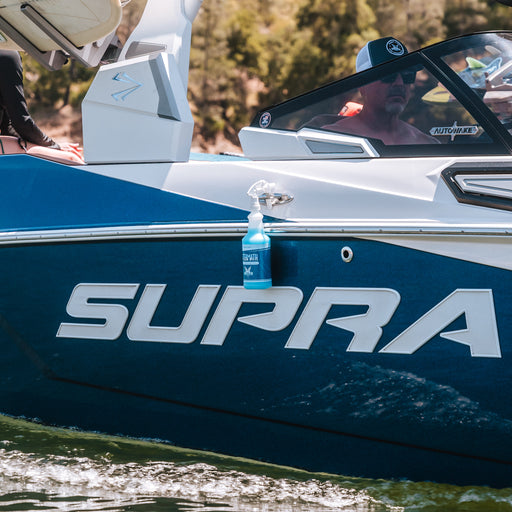
That's where Aftermath comes in. Aftermath is a lighter acidic formula than Spot Rinse, and it doubles as a detail spray. It cuts through fresh water spots, restores gloss, and leaves a slick finish thanks to light polymers in the formula. It's safe on wax, sealant, and ceramic coating, so it doesn't tear up any protection you've already put down. It's also our go-to for boat owners, who deal with hard water spots constantly.

Aftermath 32oz
Light acidic detail spray. Removes fresh water spots, restores gloss, safe on coated paint, boats, and RVs.
Shop Aftermath →
How to think about the two together: use Spot Rinse for heavy mineral buildup or any time you have visible water spotting that needs to come off. Use Aftermath for regular maintenance after every wash if you're using hard water, or as a fast wipe-down on the boat after a day on the water.
Ceramic Coatings Get Water Spots Too
A common myth is that ceramic coatings make water spots impossible. They don't. Yes, a coating repels water beautifully when it's clean. But the minerals in hard water still leave deposits on top of the coating, and given enough time those deposits will etch right into the ceramic the same way they etch into clear coat. Coated cars need water spot maintenance too. Don't skip it just because you have a coating.
Glass Has Its Own Rules
Water spots on glass behave differently than water spots on paint. Glass is a much harder surface than clear coat, which means when minerals etch into it, the etching is locked in deeper and won't come out the same way. Light mineral buildup on glass can still be cleared with Spot Rinse using the same wet method described above. But once those minerals have actually etched into the glass surface, you need an abrasive product designed specifically for glass.
That's where Glass Polish Plus comes in. It's a polishing compound built for the hardness of glass and chrome, strong enough to cut through etched water spots that won't budge with a regular spray product. Apply a small amount to a soft cloth or applicator pad, work it into the surface, let it haze, and buff it clear with a clean microfiber. It also works wonders for hard water spots on shower doors at home, which is a nice bonus.

Glass Polish Plus 16oz
Abrasive polish formulated for glass and chrome. Removes etched water spots that detail sprays can't touch.
Shop Glass Polish Plus →
Keep Glass Polish Plus off window moldings and surrounding trim. If you get residue on trim, clean it up with an all-purpose cleaner before it dries.
Wash Smart to Prevent Water Spots
Removing water spots is one thing. Avoiding them in the first place is better. A few habits go a long way:
- Wash in sections if you're in direct sun. Soap and water that dry on the paint before you can rinse them become spots.
- Dry each panel before moving on. Don't let droplets sit and evaporate, especially in heat.
- Wipe down with Aftermath after every wash. Especially if you're washing with hard water. Cheap insurance.
- Park out of sprinkler range. Sprinklers running on a parked car overnight will mineral-coat your paint by morning.
Consider a DI Water System
If water spots are a constant problem at your house, look into a deionized (DI) water system for your wash. DI water has had the minerals filtered out, so it doesn't leave deposits when it dries. It changes the whole experience of washing your car. No more racing the sun, no more drying every droplet before it sets, no more wipe-down step after the wash. It's an upfront investment, but if you wash often it pays itself back fast in both time saved and paint preserved.
If Your Water Spots Have Already Etched
Once water spots have etched into the clear coat or ceramic coating, no spray product is going to fix them. You're in paint correction territory now, which means using a polisher and an abrasive to remove a microscopic layer of clear coat until the etching is gone.
A reasonable starting point for moderate etching is Classic Cut on a microfiber cutting pad with a dual action polisher. Run slow passes with moderate pressure to break the abrasives down and cut the etching out of the clear coat.

Classic Cut 16oz
Diminishing abrasive compound. Removes moderate paint defects and water spot etching with a dual action polisher.
Shop Classic Cut →
Follow your cutting step with Classic Polish on an HDO orange foam pad. The polish refines the surface and restores the gloss the compound stage takes away. One pass with Classic Polish after Classic Cut and most paint comes back to a clean, glossy finish.

Classic Polish 16oz
One-step diminishing abrasive polish. Light correction and a glossy refined finish in a single step.
Shop Classic Polish →If Classic Cut on a microfiber pad isn't pulling the etching out, the damage is deeper than a standard correction can handle. At that point you're looking at a more aggressive compound, possibly stepping up to a rotary polisher and a wool pad, or in worst cases wet sanding. We don't recommend tackling any of that at home unless you've done it before. Wet sanding done wrong is how clear coats get ruined, and a rotary in inexperienced hands is the same story. If you've never used one, send the car to a professional detailer instead. It's cheaper than a respray.
For a full breakdown of which Shine Supply compound and polish to use based on paint hardness and defect severity, see our Compounds & Polishes Chart.
Pro Tips
- Speed wins. Fresh water spots take a couple minutes to remove with Spot Rinse. Etched spots take hours with a polisher. The longer you wait, the worse the job gets.
- Never let an acidic product dry on paint. Work small areas. Rinse or wipe before it dehydrates the surface.
- Wipe Spot Rinse off black trim immediately. Mild acid plus rubber trim is a combo to avoid.
- Don't dry your car in direct sun. Move into shade or wash in sections. The fastest way to create water spots is to fight evaporation.
- Coated cars still need water spot care. A ceramic coating is not bulletproof. Treat it like clear coat when minerals show up.
- Heat cycle after correction. If you've polished out etching, let the panel warm and cool before finishing. Spots that come back mean you need to cut deeper.
Why Spot Rinse Beats the Old Vinegar Trick
The internet's favorite home remedy for water spots is a 50/50 vinegar and water mix. It does work in a pinch. It also has real downsides. Vinegar is harsh enough to dry out your clear coat over repeated use, and it'll strip wax or sealant in the process. You're trading a short-term fix for a longer-term problem.
Spot Rinse was built specifically for this job. It's a controlled acidic formula strong enough to break down hard water deposits but engineered not to dehydrate or damage paint. Spray it on, agitate, rinse it off, and the minerals come up without the side effects. It's safe across painted surfaces, fiberglass, gel coat, and glass, which means one bottle covers the boat, the truck, the RV, and the daily driver.
The other thing that matters at scale: with Spot Rinse you can work the whole car in one session. Spray a panel, agitate, rinse, move on. With vinegar you're mixing batches, watching dwell time, and hoping you don't leave a streak. One is a detailing product. The other is a kitchen ingredient.
Don't Let Water Spots Cost You a Paint Correction
Catch them early and they wipe off in minutes. Wait too long and you're booking shop time. Spot Rinse is the move.
Shop Spot RinseFrequently Asked Questions
Can I use Spot Rinse on glass?
Yes for mineral buildup that hasn't etched in yet. Spot Rinse is safe on glass, fiberglass, gel coat, and painted surfaces. Just keep it off black trim and don't let it dry on any surface. If the water spots have actually etched into the glass, you'll need Glass Polish Plus instead. Glass is harder than clear coat, so etched spots on glass need an abrasive polish to come out.
My windshield has water spots that won't come off with Spot Rinse. What now?
The minerals have etched into the glass. Glass is much harder than paint, so once water spots etch in they need an abrasive polish built for glass. Glass Polish Plus is formulated for exactly that. Apply with a soft cloth or applicator pad, let it haze, then buff clear with a clean microfiber.
How often should I use Aftermath?
After every wash if you're washing with hard water. Otherwise as needed, any time you notice fresh water marks on the paint. It's designed for regular use.
Will Spot Rinse remove water spots that have already etched?
No. If the minerals have eaten into the clear coat or coating, you need paint correction with a polisher. Spot Rinse removes the mineral deposit on the surface. It doesn't repair damage that's already in the paint.
Is Spot Rinse safe on ceramic coatings?
Yes, when used as directed. Spray, agitate, rinse promptly. Don't let it dwell or dry on the surface. The same rules that apply to clear coat apply to coated paint.
My water spots came back after I polished them out. What happened?
The clear coat heat cycled and reflowed, which can pull etching back to the surface. You didn't cut deep enough. Run your correction again with a slightly more aggressive approach, then heat cycle the panel before finishing to confirm the spots are actually gone.
What's the difference between Spot Rinse and Aftermath?
Spot Rinse is the stronger of the two. It's a dedicated water spot remover for heavier mineral buildup, used as needed. Aftermath is a lighter acidic formula that doubles as a detail spray for regular maintenance after every wash. Use Spot Rinse for visible water spotting. Use Aftermath to keep new spots from setting in.